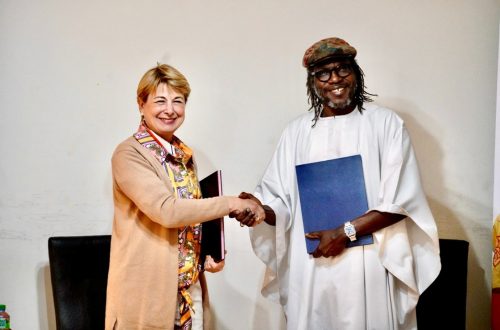
My name is Djibril Fall, I am African and a Senegalese national. Like many of us who do it quietly, I aspire to make my time on earth useful to as many people as possible, starting with those who need it most.
I believe I have had the immense good fortune that God guided my personal and professional commitment toward the defense of human dignity, alongside children and young people. It is a stroke of fortune given everything a child represents, both in the spiritual symbolism of my religious and traditional beliefs and in the concrete outcomes that can result from properly supporting such a being. It is a chance to be able to continue a tradition upheld both by our African cultures and by the religious beliefs that guide our lives today.
As I write these words, I think of everything I was taught by Mame Abdou and Serigne Saliou. And I admit I am afraid! The fear of a simple, perhaps uneducated human being who keeps turning over what he has learned from the teachings of the Prophet Muhammad (PBUH) regarding his relationship with children. I am afraid because what I see and what I hear bears no resemblance to what I was taught about my religion.
My religion has recognized the child as a being “without sin,” in other words a being who has never “done anything wrong,” who is not “responsible.” So I want to understand why we would harm someone who has “done nothing wrong” in the “eyes” of God.
The argument put forward by those who defend the mistreatment of talibé children is simple: “we went through the same thing, and yet here we are today.” Gentlemen, I tell you: you are survivors! But how many did not survive? How many were scarred for life? How many turned out badly?
A survivor can develop three attitudes toward these tormentors: visceral hatred that leads to a strong, unchecked desire for revenge; unconscious sympathy, nicknamed Stockholm syndrome; or complete denial of one’s history of abuse, which often pushes one to build a new life.
All this to say that whatever way a victim of abuse reacts, that person needs personal support, social support, and a public system that guarantees their wellbeing. The Quranic teachers who reproduce toward children the same system of abuse they themselves experienced — and who, moreover, defend it — also need to be helped, supported, and strengthened. And this is the responsibility of religious and political authorities.
My name is Djibril Fall, and I work within the West Africa Network for the Protection of Children, the RAO. Our work is to restore dignity to vulnerable children without family ties and to support them in their development prospects, wherever they may be in our region.
No! Defending the dignity of a human being is not being a freemason or serving the enemies of Islam! No! Denouncing abuse is not an act dictated by the West. We are Africans, and we also follow the guidance of our oldest texts, those that governed, for example, a great empire like the Mandé, where the dignity and physical integrity of the child were guaranteed.
Yes, we will mobilize legitimate resources wherever they may be found, to protect, support and ensure the dignity of our children and their future. But we do so in full coherence with our beliefs.
Dr. Djibril FALL